Mohammed Alguthmi: The Cellist Who Lit the Way
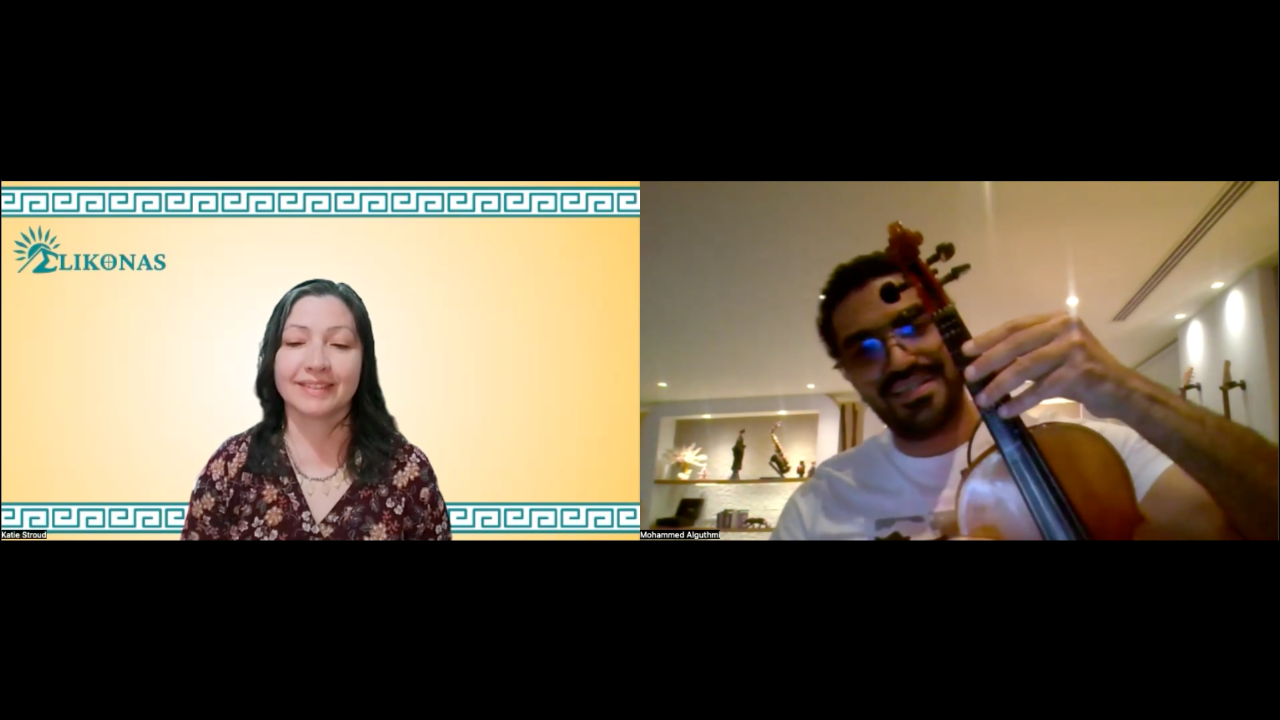
In the eighth episode of What's Your College Story?, Katie sat down with Mohammed Alguthmi — businessman, cellist, and inventor — joining from Riyadh, the capital of Saudi Arabia. On paper, Mohammed's story looks like a straight line: a BA from Jordan, a master's in business from the UK, a factory, a career. In practice, it curves sharply at the point where grief meets music — and ends, so far, with a startup invention that could change how string instruments are taught around the world.
Built for Business, Drawn to Music
Mohammed grew up in a retail family. His father founded one of the largest retail companies in Saudi Arabia. Business was the air he breathed from childhood, and he followed that path through university — earning his bachelor's degree in Jordan before completing a master's in business in the UK.
I came from a retail family. My father founded one of the biggest retail companies in Saudi Arabia — curtains. It's been business since I was a kid.
But I've been passionate about music since college. I enrolled in one of the music schools in Jordan to learn guitar. It was a hobby. I enjoyed it. I love listening to music. But then there was a whole period — from when I graduated from university until my divorce — where music was quiet.
Back in Saudi Arabia, he built a medical plastics factory. The degree served its purpose. The business ran. And music stayed in the background — a hobby, a memory of guitar lessons in Jordan — until the moment it didn't.
Grief, a Piano, and a Cello
My story with music began with my grieving. I'm separated, and music was my cave. So I bought a piano and started learning piano. Then, in 2019, I started my journey with cello.
It became somehow professional — playing in gigs and exhibitions. And because I'm a self-taught musician, I learned through YouTube, through websites. Back then in 2019, we didn't have any cellists or music schools in Saudi Arabia.
There was something about the cello, specifically, that stopped him. He'd played guitar. He'd explored the piano. But the cello was different — lower, slower, richer in the way it seemed to carry feeling without words.
I found this instrument so deep. It's different than any other instrument.
He taught himself almost entirely from YouTube. There were no teachers to find, no schools to enroll in — because in 2019, music education in Saudi Arabia was just beginning to exist.
A Country Rediscovering Its Voice
That context matters. For years, music in Saudi Arabia existed in a complicated relationship with religious and cultural restrictions — not forbidden outright, but constrained, certainly not publicly celebrated or institutionally taught. That began to shift dramatically under Crown Prince Mohammed bin Salman and the country's Vision 2030 reforms.
The new regime changed everything in Arabia upside down — regarding culture, regarding music, regarding innovation. So many fields in Saudi Arabia have been developed in the past seven or eight years. Women driving. Theaters. Music schools. We have commissions now in all aspects of culture: fashion commission, music commission, theater commission, movies commission.
We were missing that part — the cultural part in Saudi Arabia. And now it's boomed, in a great way. That gave an opportunity to me, and to many people, to be more involved in culture — music, theaters, all the fields.
Mohammed was careful not to wade into politics, and that's not what this story is about. But the shift is real, and for him — and for the students who will eventually use what he's building — it matters enormously that it happened.
The Problem with Fretless
As Mohammed taught himself cello, he kept running into the same wall every beginner hits: there are no frets.
On a guitar, small raised markers run across the neck, dividing it into precise positions. You can feel where to put your fingers. On a violin or cello, the fingerboard is smooth. There is nothing to guide you. Finding the right note requires training your ear and your muscle memory simultaneously — and for beginners, that's genuinely hard.
I'm into technology and innovation since I was a kid. And a light came on about why string instruments are really hard to play — there is something I could develop to help students learn. Fretless instruments like the cello and violin are challenging to learn, especially in a short period. And so I've been finding a way, a solution — something to teach students.
The solution he came up with is called MaqAura.
MaqAura: Light on the Fingerboard
The name blends two roots: maq, from the Arabic word maqam meaning musical scale, and aura — the life that radiates from living beings. Together: the life of musical scales radiating from your instrument.
The device itself is a paper-thin circuit board embedded with LED lights, designed to sit beneath the strings on the fingerboard of a violin, cello, oud, or qanun — without touching the strings or affecting the sound at all. When connected via Bluetooth to the MaqAura platform, the lights illuminate the exact finger positions for whatever note or scale the student is learning.
The real magic behind this technology is the controller. I'm developing a small controller with a microphone and speaker — where you can speak with the instrument through AI. There is a specific music AI agent that can help you with whatever music questions or inquiries you have about music skills, music information. You can speak with your instrument and it replies. It can also create lessons for you. When you ask about a music scale, it shows you the exact scale on the fingerboard so you can practice immediately.
The platform behind MaqAura is a full two-year curriculum covering violin, cello, oud, and piano, built to take a student from complete beginner to genuinely capable player. Mohammed is already signing agreements with music schools, universities, and private schools to integrate the technology into their classrooms. Teachers from anywhere in the world can register on the platform and offer lessons online to students anywhere else — connected through the same tool that lights up the notes.
MaqAura is currently a pre-seed startup. Mohammed gave Katie a live demo during the episode, and the simplicity of the idea — LED lights showing you where to put your fingers, guided by an AI agent you can talk to — is immediately compelling.
I'm not a violinist. And now I can play a little violin — in one week, actually. That's one of the things.
Why His Story Matters to Elikonas
Mohammed Alguthmi has a master's degree in business. He also taught himself to play cello from YouTube videos at a time when there were no music schools in his country. He went from grief to gigs. He took a problem he encountered as a learner and turned it into a product — one that is already being adopted by institutions and that could eventually make string instruments learnable by anyone, anywhere, regardless of whether they have access to a qualified teacher.
That last part is worth sitting with. MaqAura is, at its core, a tool for closing the access gap in music education — the same gap that Elikonas is working to close in education more broadly. The knowledge exists. The desire to learn is real. What's often missing is the bridge: the right tool, the right guide, the right way in.
Mohammed's path through pain into purpose — and from there into invention — is exactly what this show exists to document. His learning didn't happen in a classroom. It happened on YouTube, in grief, in a country that was itself just beginning to give that kind of learning a place to exist. And out of it came something new and beautiful.
We can't wait to see MaqAura in Elikonas profiles one day.
Watch the Full Episode
Watch the full conversation — including Mohammed's live demo of the MaqAura device and platform — on YouTube. And if you know anyone learning a string instrument, this one is worth sharing.
To learn more about MaqAura, visit Mohammed's website — link also in the YouTube description below the video.
Take our survey! (And share)
Elikonas is currently in development — and we're building it with real learners in mind from day one. Take our short survey and help shape what the platform becomes.
Share YOUR College Story
Every week on What's Your College Story?, we sit down with real people and talk about their real education journeys. The winding ones. The interrupted ones. The ones that took longer than expected and meant more because of it.
If you have a story to share, we'd love to feature you — either as a podcast guest or in a written profile right here on the blog. Email us and submit your story, or just let us know that you'd like to chat. We'll either turn that chat into a blog post or schedule you to be on the show. Whatever is most comfortable for you.
The more voices we gather, the stronger the case becomes: education is not a straight line, and why would it be? Those paths are as unique as you are!
About What's Your College Story?
What's Your College Story? is a weekly podcast hosted by Katie Stroud, founder of Elikonas, Public Benefit Corporation. Each episode features a real conversation with a real person about their education journey — the detours, the discoveries, and everything in between. The show exists to celebrate non-traditional paths and to build the community that Elikonas will serve. New episodes drop every week. Subscribe on YouTube or wherever you listen to podcasts.
Elikonas is a mission-driven platform expanding equitable access to education and workforce development — connecting learners, education providers, and employers in ways that increase opportunity, economic mobility, and skills attainment. Coming soon.