John Edward Ryan: Live for Your Calling
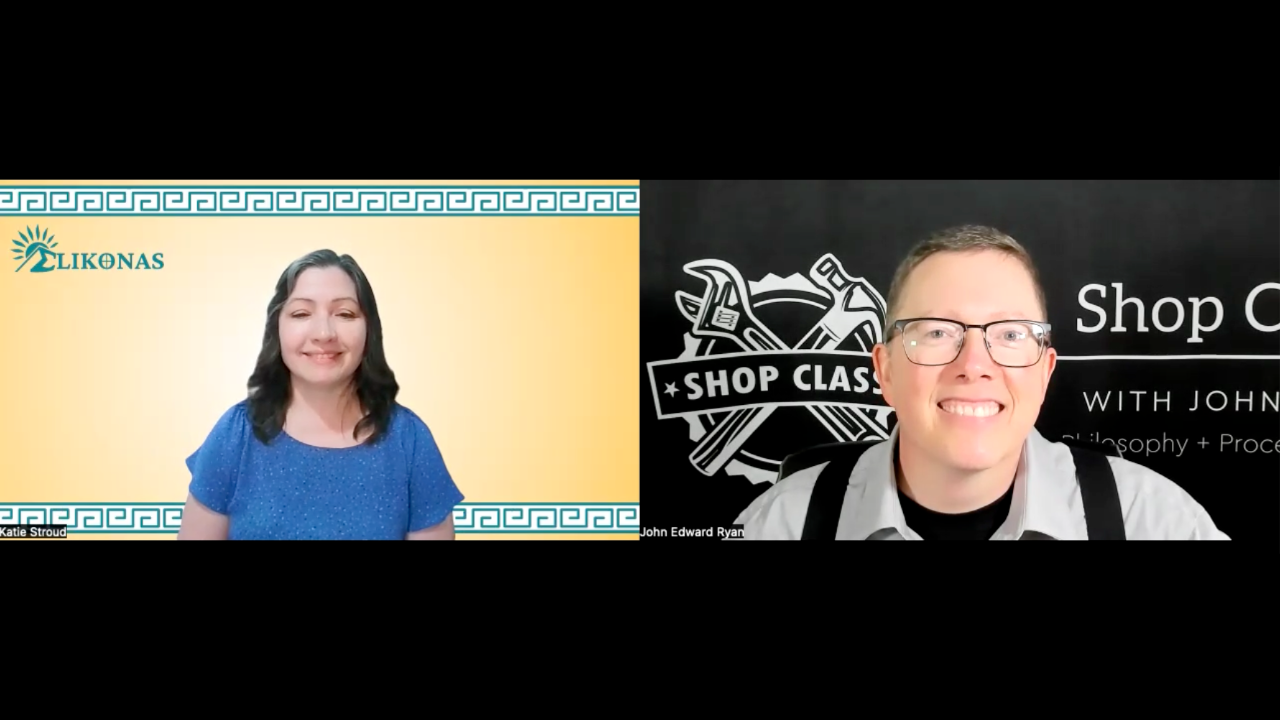
In the sixth episode of What's Your College Story?, Katie sat down with John Edward Ryan — financial coach, Prudential advisor, and the man behind a workbook-turned-life-philosophy called Shop Class. John grew up on a farm in New York State, thought of college as "13th and 14th grade," and at 18 years old walked into a local factory and started an apprenticeship instead. That decision turned into a 28-year career — first as a toolmaker, then as a leader, a coach, and eventually a teacher of the financial and personal tools he wished someone had handed him earlier.
His story isn't a cautionary tale. It's the opposite.
The Farm Kid Who Skipped 13th Grade
I was a farm kid that knew about earning money. Getting paid by the hour was attractive to me. I kind of thought of college as 13th and 14th grade — right or wrong.
I was very lucky. There was a small manufacturing company right in my hometown, and they were poised for a lot of growth. I found an apprenticeship opportunity there and became a toolmaker apprentice. That's the very foundation of my story.
For John, the fit was immediate. Coming from a farm background where broken things got fixed — not replaced — the machine shop felt like a natural extension of everything he already knew. When things broke down, you figured it out. That translated directly to the tool room.
Shop Class was born in 1992. That's when John started — 40 hours a week on the factory floor, technical school in the evenings. The curriculum was exactly what he needed: drafting (before CAD, still taught on a physical drafting table with protractors and erasers), welding, shop math, algebra. No English class. No social studies. No fluff.
For me, it fit perfectly. And that led to many, many more opportunities.
28 Years in the Tool Room
The small manufacturing company John joined grew into a technology company over the decades. He stayed — with one departure and return — for more than 30 years total. Early on, he earned a small raise every six months as he progressed through the apprenticeship. Later, he moved into leadership: hiring, coaching, mentoring the next generation of skilled tradespeople.
From the inside, he watched the cultural shift happen in real time. The company ran a respected apprenticeship program. Recruiting into it, John found, came in waves — sometimes easy, often frustratingly hard — as the broader culture pushed more and more young people toward four-year degrees and away from the trades.
The push for almost every kid to go to college was game on. And if kids went off to learn a vocation, they were looked down upon. It was just negative. And I think what happened — as an apprentice, we were taking those classes at night, getting a little raise every six months, and thinking: this is working for me. I loved it. But the stigma never really went away.
He watched it shift again around COVID — a moment that accelerated things already in motion. Now there's a public movement calling for more carpenters, electricians, plumbers, auto mechanics, factory workers. The trades are having a cultural moment. John thinks the lag is still real, though. Moms and dads, he says, haven't fully let go of the idea that a degree is the only respectable path forward.
Shop Class: Tools, Philosophy, Process
After decades of working, leading, and coaching, John began putting his philosophy into a framework. He calls it Shop Class — a workbook built around three pillars:
- Tools — the practical instruments people use (or misuse) every day: spending plans, budgets, apps, sleep habits, investment vehicles, financial strategies. The world is rich with good tools; most people are using the wrong ones, or the right ones incorrectly.
- Philosophy — the beliefs and lenses people carry, often without examining them. Why do I treat money the way I do? What did my family teach me about wealth, work, and worth? Where did those ideas come from, and are they still serving me?
- Process — the daily habits and systems that either move people forward or keep them stuck. When you become intentional about your process, you can start to make traction. Subtle changes compound.
The goal isn't to turn everyone into a financial expert. It's to help people become self-aware enough to find a path — any path — that leads somewhere they actually want to go.
Job. Career. Calling.
One of John's simplest and most useful frameworks is the progression he calls the big three: job, career, calling.
It's pretty rare to come out of high school — or even out of college — and the thing you've chosen is your calling. That can happen. Someone's hyper-talented, someone's naturally gifted. But I think of a job as a huge thing. A career is an improvement over that. And if your finances are square and you can lean into a calling — it might not even be your exact vocation — but doing what you love? That's the sweet spot.
The world we live in is so rich with technology, so rich with opportunity. But we've made the bottom rungs of the ladder harder to find. We've removed them in some ways through technology and robotics and AI. The things that used to be the first places to grab and start to climb — they're not there in easy, obvious abundance the way they used to be.
This is where finances matter, John argues. Not as an end in themselves, but as the foundation that makes everything else possible. When the basics are squared away — when you're not constantly reacting to the next emergency — you create space to listen for a calling, pursue it, or build something of your own.
The Butter Knife Problem
One of the most memorable moments in the conversation came when Katie described how her mother handled saving money as a single parent of four kids: she'd claim single on her tax withholding, take home slightly less each paycheck, and collect a larger refund at tax time to catch up on bills.
John recognized it immediately — and named it.
That was a tool. It worked. But it's the butter knife as a screwdriver. It gets the job done — it's certainly not optimal — but nobody taught her a different way. That's exactly what Shop Class is about: figuring out which tools you're using, understanding why you're using them, and finding better ones when better ones exist.
Nobody handed Katie's mother a financial toolkit. She improvised with what she had. John's work is about closing that gap — giving people the awareness and resources to upgrade from the butter knife.
Why His Story Matters to Elikonas
John Edward Ryan went through an apprenticeship. He went to technical school at night. He attended leadership trainings and industry events. He built a coaching practice and wrote a workbook. He's spent decades learning — and none of it shows up on a traditional transcript.
When Katie described Elikonas to him — a platform where people can build a profile that captures all the learning that doesn't fit on a résumé or a LinkedIn page — John's response was immediate: "It's a way to give people a positive lift on the resume for good character."
That's the spirit of it exactly. Shop Class itself is the kind of thing that should be an ed-unit in someone's Elikonas profile — proof that you've thought seriously about your finances, your tools, your process, and your direction. That you've done the work. That you've shown up for yourself.
And John's own story — toolmaker apprentice to financial coach — is a complete education in itself, one that no four-year institution granted him. Elikonas is being built so that stories like his have somewhere to live.
Watch the Full Episode
Watch the full conversation between Katie and John on YouTube. If his story resonated with you — or if someone you know needs to hear that there's more than one road — share it.
And if you want to get your hands on John's Shop Class workbook — a real, physical workbook — head to JohnEdwardRyan.com and request a copy. It's free.
Take our survey! (And share)
Elikonas is currently in development — and we're building it with real learners in mind from day one. Take our short survey and help shape what the platform becomes.
Share YOUR College Story
Every week on What's Your College Story?, we sit down with real people and talk about their real education journeys. The winding ones. The interrupted ones. The ones that took longer than expected and meant more because of it.
If you have a story to share, we'd love to feature you — either as a podcast guest or in a written profile right here on the blog. Email us and submit your story, or just let us know that you'd like to chat. We'll either turn that chat into a blog post or schedule you to be on the show. Whatever is most comfortable for you.
The more voices we gather, the stronger the case becomes: education is not a straight line, and why would it be? Those paths are as unique as you are!
About What's Your College Story?
What's Your College Story? is a weekly podcast hosted by Katie Stroud, founder of Elikonas, Public Benefit Corporation. Each episode features a real conversation with a real person about their education journey — the detours, the discoveries, and everything in between. The show exists to celebrate non-traditional paths and to build the community that Elikonas will serve. New episodes drop every week. Subscribe on YouTube or wherever you listen to podcasts.
Elikonas is a mission-driven platform expanding equitable access to education and workforce development — connecting learners, education providers, and employers in ways that increase opportunity, economic mobility, and skills attainment. Coming soon.