Chronically Unwilling to Guild Master
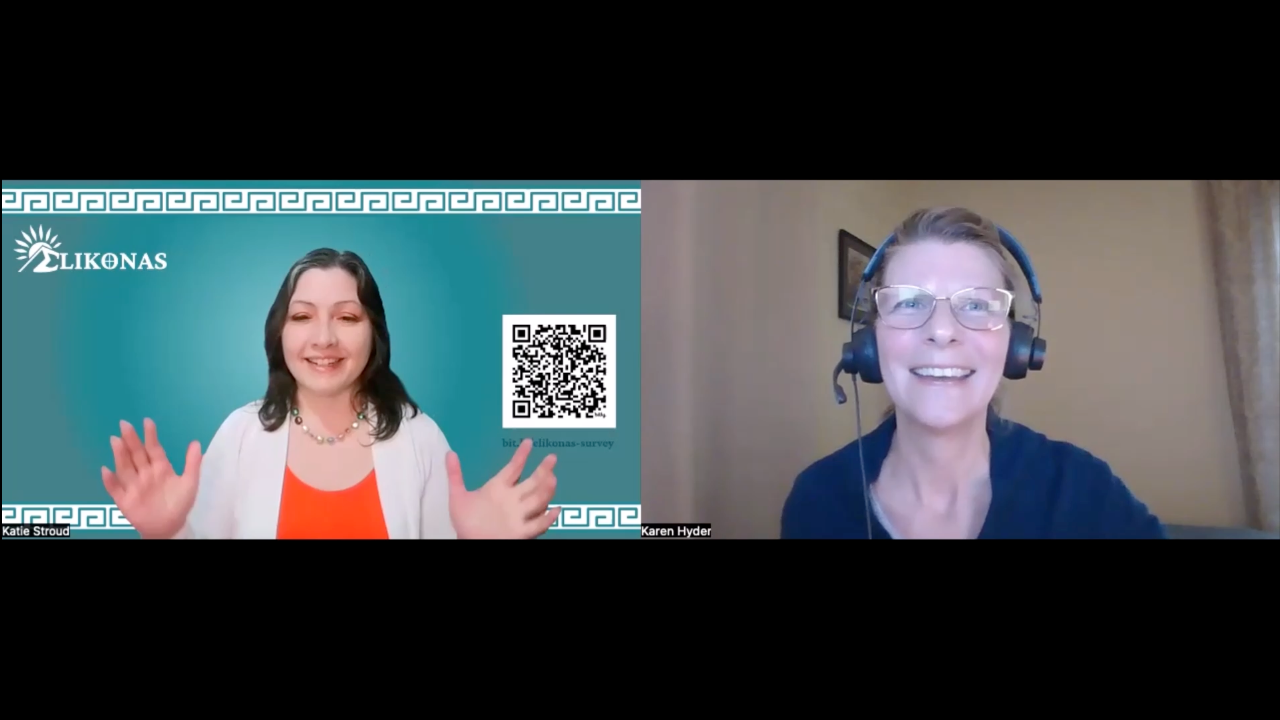
In the fourth episode of What's Your College Story?, I sat down with Karen Hyder — a trainer, event producer, speaker coach, virtual learning pioneer, and eLearning Guild Master whose résumé somehow still doesn't capture everything she's actually done. I've known Karen from my own L&D conference days, but I didn't know her story was so much fun!.
This week's recap is special: Karen wrote it herself, in her own words. What follows is her story — from a Catholic school in Buffalo to a college writing center, from teaching Turkish police officers English at a dining room table to pioneering online trainer certification in London, from cobbling together gig work in a farmhouse with satellite internet to helping shape the entire field of virtual eLearning. I've added a few bookends. The rest is all Karen.
— Katie
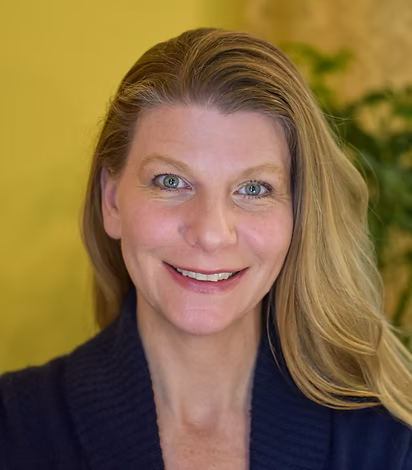
About Karen Hyder
Karen Hyder, Certified Technical Trainer CTT+, is a trainer of trainers, online-event producer, and speaker coach. Internationally known, innovative voice in the evolving, multifaceted eLearning space, her insights and practices continue to shape the ways in which instructional designers, software developers, teachers, and leaders achieve meaningful engagement with their learners.
You can learn more at Karen Hyder
The Chronically Unwilling Student
I grew up near Buffalo, NY — Go Bills and Go Sabres! I attended a Catholic grammar school for nine years and then an all-girls private high school run by nuns. Shout-out to the Sisters of Mercy, who educated the chronically unwilling. I wasn't a strong student, but I always had my head in a book — I once skipped school to finish a Stephen King novel. When I wasn't reading, I loved organizing, optimizing, and planning things, like surprise parties.
I took college entrance courses, including three years of Spanish, typing, and an introduction to personal computers, where we learned about "documents," also called "files." These were big concepts at the time. At church, I helped plan and produce confirmation programs and retreats, and for service work, I cared one-on-one for children with disabilities.
Seven Jobs and a Literature Degree
I graduated at 17 and headed to college 100 miles away, my boxes packed by the Fourth of July. I studied psychology, German, British and American literature (a far more compelling way to understand psychology), and communications. For technical writing, Dr. Lawrence required us to submit papers electronically using WordPerfect 3.0 for DOS — an ugly program with bright orange text on a black screen.
Alongside a full course load, I worked constantly: washing dishes, serving food in the dining hall, and coaching peers in the Writing Center. Off campus, I babysat, waited tables, worked retail, did handy work, and taught English as a second language. I want to point out that saying I went to private school gives people the idea that cash was flowing readily through my life — it really wasn't. Once the tuition was paid, they didn't really want to hear from me. Seven jobs was the reality.
I loved the Writing Center. It taught me to meet people where they were — to offer specific guidance when needed and broader instruction when confidence was the real barrier. Many of the students I worked with were trying to pass the TCW (Test for Competency in Writing), sometimes after multiple attempts. That experience shaped how I think about teaching: with empathy, clarity, and purpose.
From the Writing Center to the Dining Room Table
A small card on a bulletin board changed my trajectory. Berlitz Language Schools was hiring English teachers. I sat across from businessmen from companies like Kodak, Xerox, and Bausch & Lomb — representing countries such as Japan, Brazil, Turkey, Germany, and Mexico — and then visited their families at home to teach them too. Six Turkish police officers for nine months. I loved the cultural exchange as much as the language instruction.
"Kareeen, what means 'paper or plastic'? Why they ask me this when buy the food?"
That first summer, I even earned internship credit toward my degree. One of my students once told me that when I first came to her, she didn't understand a word I said and wanted to cry. By the time we had that conversation, there was no obstacle left between us. Watching someone cross from confusion to fluency — that's what teaching is for.
The Teddi Project and the Skills No Transcript Captures
Despite carrying a full course load for eight semesters and working multiple jobs, a friend decided I had too much free time and recruited me to help produce the Teddi Project Dance for Love — a 24-hour fundraising marathon for Camp Good Days and Special Times, honoring Teddi Mervis, a local girl who had lost her battle with cancer and probably would have been our contemporary at college had she lived.
I was responsible for coordinating musical acts — some performing in the middle of the night. I pulled together local bands, radio DJs, Arthur Murray Dance Studio, and one year, Lou Gramm from Foreigner — who couldn't sing due to contractual restrictions, but showed up anyway. I sang to him instead.
Our communications professor, Dr. Lou Buttino, later created a documentary production course where we wrote, directed, filmed, logged, and edited a documentary about Teddi's legacy. It was demanding, meaningful work — done for love and for credit.
None of this showed up on my transcript. But the skills I built — event coordination, volunteer management, speaker recruitment, production logistics — would define my career for the next thirty years.
"Her."
A few years after graduation, I walked into an interview at Logical Operations, a technology training company. They asked what I knew about computers. I knew WordPerfect for DOS. They asked me to teach them something.
I demonstrated the Berlitz Method: "This is a thing. What is this? It's a thing."
When I left the room, I later learned, the panel of nine managers and trainers looked at each other and said, unanimously: "Her."
I stayed for nine years, eventually serving as Director of Trainer Development. I taught hundreds of learners each week from organizations like Kodak, Xerox, and the University of Rochester — and trained trainers to do the same. Our instructional model — Set Up, Delivery, Follow-Up — was a more learner-centered evolution of the old "tell them, tell them, tell them" approach. I later expanded that into a new framework, though that's a story for another time.
London, Monaco, and the Renegade Trainer
As my career grew, so did my travel schedule. Relentless road warrior years eventually led my husband and me to make a leap: we moved to London, where I built a trainer certification program from scratch. I immersed myself in British culture, re-read all of my British literature, and adapted my train-the-trainer course. In a very American way, I encouraged trainers to step out from behind the podium and engage with learners directly — asking questions instead of just delivering information. It was revolutionary for many.
While there, I also studied Neuro-Linguistic Programming with Richard Bandler, Paul McKenna, and Michael Breen, joining the NLPlay group and forming enduring friendships. My mind was blown and my training skills developed to a new level.
Around that time, I reconnected with Heidi Fisk and David Holcombe, conference leaders I knew from earlier work. Through Influent conferences — held in places like Barcelona and Monte Carlo — I presented sessions, coached speakers, and eventually led a track, shaping content and recruiting presenters to speak for free. At a rooftop reception overlooking Monaco's marina, surrounded by yachts, I remember thinking: this is one of those surreal, once-in-a-lifetime moments.
The Farmhouse, the Satellite Internet, and the Future of Training
Eventually, my husband and I returned to the U.S. in search of a quieter life. We bought an old house on a hilltop and began restoring it — splitting wood, digging in the dirt, and living with limited internet that barely supported email.
I continued training independently, piecing together work while adapting to a changing industry. Then, in 1999, an opportunity with Morgan Stanley changed everything. Their team asked me to design a train-the-trainer program using PlaceWare (later Microsoft Live Meeting) so their instructors wouldn't need to fly internationally. I built and delivered the program — and in doing so, launched my career in virtual learning.
At first, I couldn't even teach from home due to limited internet access. I drove ten miles to a rented office for a reliable connection, often working in the middle of the night to align with global time zones. Still, I had found what I'd been imagining for years: a way to teach from anywhere.
Shaping a Field
In 2004, I began working with the eLearning Guild — leading webinars because I was one of the few people actively teaching others how to teach online. What started as one day with three sessions grew into a major annual program. I became an online event producer and speaker coach, helping shape the field of virtual eLearning as it expanded.
Along the way, I wrote articles and contributed to books — writing introductions, reviews, and a chapter on accessibility in virtual classrooms for Design for All Learners: Create Accessible and Inclusive Learning Experiences, edited by Sarah Mercier. My blurbs appear on seven covers. I joined the board overseeing trainer certification and helped push for a virtual credential: the Virtual Certified Trainer (VCT+). In 2017, I was honored as an eLearning Guild Master.
For the past decade, I've worked with Hearing First, a nonprofit producing hundreds of live, online learning experiences for professionals who work with deaf and hard-of-hearing children and their families.
Looking back, the through-lines in my work have been remarkably consistent. Event production, in all its forms, has been a constant thread — from 24-hour dance marathons to global conferences to live online events. One-on-one teaching has never been far behind, from the Writing Center to Berlitz to virtual speaker coaching. And woven through it all is technology: from WordPerfect and "files" as new concepts, to teaching first-time computer users, to pioneering virtual classrooms. Different chapters, same story.
A Few More Things Katie Wanted to Know
At the end of every episode, Katie asks guests two questions and one more for fun. Here are mine.
Favorite thing to learn? Other cultures and language. Give me someone willing to teach me about where they come from, and I will sit and listen to every word.
The hardest? Financial planning as a gig worker. When income swings wildly from month to month, you get very good at MacGyvering your finances — or you don't survive. I've developed my own system: plan backwards from the worst case, keep conservative reserves, and try not to lose sleep the night before a live event. I have techniques for that too.
One thing I want more people to know about me? I use vision boards. Have for years. I know it sounds woo-woo. I don't care. They help me stay focused on what I actually want — and get better at saying no to what I don't.
(For the record: Katie and I both agreed that "woo woo" is, itself, an idiom. I awarded her a wooden nickel.)
Why Karen's Story Matters to Elikonas
Karen's career is a near-perfect illustration of what Elikonas is being built to recognize. Seven jobs through college. A literature degree she describes as "really a psychology degree." A writing center job that became a Berlitz teaching career that became a nine-year training directorship. A 24-hour dance marathon that became a lifelong skill in event production. Sabbaticals. Gig work. A farmhouse. London. Monaco. A certification she helped invent.
None of that is on her transcript.
Today, there's no single place where a story like Karen's can be told in full — where every thread connects, where the Writing Center and the Monaco rooftop and the 1999 PlaceWare course and the Guild Master honor all belong to the same person and the same journey. Elikonas is building that place. Because Karen's story doesn't fit in a box. It never did. And it never should have had to.
— Katie
Watch the Full Episode
Watch the full conversation between Katie and Karen on YouTube. If her story resonated with you, share it with someone who needs to hear it.
Take our survey! (And share)
Elikonas is currently in development — and we're building it with real learners in mind from day one. Take our short survey and help shape what the platform becomes. Early respondents will get first access when we launch.
Share YOUR College Story
Every week on What's Your College Story?, we sit down with real people and talk about their real education journeys. The winding ones. The interrupted ones. The ones that took longer than expected and meant more because of it.
If you have a story to share, we'd love to feature you — either as a podcast guest or in a written profile right here on the blog. Email us and submit your story, or just let us know that you'd like to chat. We'll either turn that chat into a blog post or schedule you to be on the show. Whatever is most comfortable for you.
The more voices we gather, the stronger the case becomes: education is not a straight line, and why would it be? Those paths are as unique as you are!
About What's Your College Story?
What's Your College Story? is a weekly podcast hosted by Katie Stroud, founder of Elikonas, Public Benefit Corporation. Each episode features a real conversation with a real person about their education journey — the detours, the discoveries, and everything in between. The show exists to celebrate non-traditional paths and to build the community that Elikonas will serve. New episodes drop every week. Subscribe on YouTube or wherever you listen to podcasts.
Elikonas is a mission-driven platform expanding equitable access to education and workforce development — connecting learners, education providers, and employers in ways that increase opportunity, economic mobility, and skills attainment. Coming soon.