Why Learning Stalls: Maslow's Hierarchy of Needs and What It Means for Your Career Path
Have you ever tried to focus on learning something new while you were stressed about money, or exhausted, or in a job that made you feel invisible? You probably noticed that the information just wouldn't stick. That isn't a character flaw. It is how human beings are wired.
In our last "What's Your College Story" show, we interviewed Troy Kindle, a professional in the field of learning and development (L&D) who is pursuing his doctorate, talked to us about Maslow's Hierarchy of Needs. I thought it would be an insightful resource to post an article that goes a little deeper into what it is, how it impacts learning, and how Elikonas is being built to meet people where they're at and help them elevate to higher levels.
Almost 80 years ago a psychologist named Abraham Maslow offered a framework for how people function at different levels of need. Understanding his framework doesn't just explain why learning is hard. It explains why so many career paths stall before they start — and what it actually takes to help people move forward.
Where the Theory Comes From
In 1943, psychologist Abraham Maslow published "A Theory of Human Motivation" in the journal Psychological Review. If you want to read the original paper in full, it has been made freely available through Classics in the History of Psychology at York University.
Maslow's central argument was straightforward: human beings have a layered set of needs, and lower-level needs tend to dominate our attention until they are reasonably satisfied. Only then do we have the mental and emotional space to focus on higher-level pursuits — like learning, growth, and becoming the person we want to be.
The pyramid most people picture wasn't actually drawn by Maslow himself. It was popularized later. But the structure of his thinking has endured because it maps so closely to lived human experience.
The Five Levels
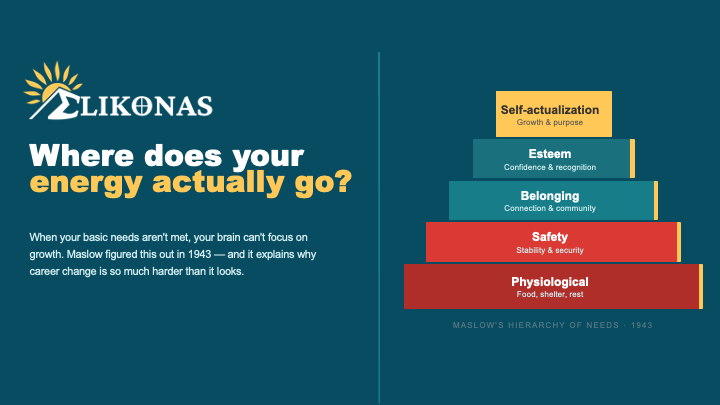
Maslow described five layers of human need, moving from the most fundamental at the base to the most aspirational at the top.
1. Physiological needs
Food, water, shelter, sleep, warmth. These are survival needs. When they aren't met, nothing else matters. A person who is hungry, exhausted, or without stable housing cannot meaningfully concentrate on a course, a certification, or a career pivot. The body overrides everything else.
2. Safety needs
Security, stability, freedom from fear. This includes physical safety but also financial safety — knowing that the bills will be paid, that the job won't disappear overnight, that there's a floor beneath you. When people are living in a chronic state of insecurity, their brain is effectively in a threat-detection mode that leaves little bandwidth for learning or long-term planning.
3. Love and belonging
Connection, community, the sense of being accepted and valued by others. This need shows up in learning environments in powerful ways. People who feel isolated, judged, or like they don't belong tend to disengage — not because they lack ability, but because the social conditions for learning haven't been met. This is one reason why the culture around education matters as much as the content.
4. Esteem needs
Self-respect, confidence, recognition, the feeling that your efforts and abilities have value. Maslow described two dimensions here: the internal experience of dignity and competence, and the external validation of others. For many people navigating career change — especially those who have been told, directly or indirectly, that skipping college means settling — this level is where the deepest damage happens. A lifetime of messaging that says "you're less than" quietly erodes the foundation that learning requires.
5. Self-actualization
This is Maslow's term for becoming fully yourself — realizing your potential, pursuing growth because you genuinely want to, doing work that feels meaningful rather than just necessary. It's the level where curiosity thrives and lasting learning happens. It is also the level that most conventional career advice aims at while ignoring every layer below it.
What This Means for Learning
The hierarchy isn't a rigid staircase — Maslow himself clarified in later writing that needs don't have to be completely met before the next level becomes relevant. But the general pattern holds: the more unmet needs a person carries, the harder it is to engage with learning in a deep and lasting way.
Think about what the typical career advice ecosystem asks people to do. It says: figure out your passion, invest in your skills, build your network, take that course. All of that is Level 5 thinking applied to people who may be navigating Levels 1 through 4. The advice isn't wrong, exactly. But it lands on soil that hasn't been prepared.
This is especially true for people who didn't follow a traditional college path. They are often managing financial pressure and job instability at the same time as they're trying to figure out what to do next. They may feel like they don't belong in "professional development" spaces designed with degree-holders in mind. And they've often internalized a message — from schools, from employers, from culture — that without a diploma, their ceiling is lower. That message is false. But it does real damage at the esteem level, and that damage slows everything down.
What Elikonas Does About It
We want to be honest: Elikonas cannot pay your rent or solve your housing situation. No platform can replace the foundational needs at the base of Maslow's hierarchy. What we can do is work thoughtfully with the levels we can influence — and reduce the friction that makes everything harder.
Making people aware
The first thing that helps is simply knowing that the struggle is real and has a name. When someone understands that their difficulty focusing isn't laziness or lack of motivation but is actually a predictable human response to unmet needs, something shifts. The self-blame decreases. The ability to problem-solve increases. Awareness is not a small thing.
Removing time pressure
One of the cruelest features of conventional education is that it forces people to learn at a pace set by someone else's schedule. When you're already managing stress at the physiological and safety levels, being told you have six weeks to complete a course or lose your spot adds pressure you don't need. At Elikonas, we are building pathways designed around your timeline — not ours.
Offering a personal network of support
The belonging and esteem levels require human connection. Not just content. We are building a community where people on non-traditional paths can find each other, share what's working, and feel genuinely seen. You are not in this alone, and you shouldn't have to learn that only after you've already figured everything out.
Taking the thinking out of finding a path
fatigue is real, and it hits hardest when you're already carrying a lot. One of the most paralyzing experiences for career changers is not knowing where to start — facing a dozen options with no clear framework for evaluating them. Elikonas is designed to reduce that cognitive load. Our Career Path Decision Framework helps you move from "I don't even know what I don't know" to a clear, concrete direction — without requiring you to become an expert in workforce development to get there.
Repairing esteem by removing stigma
This one matters to us a great deal. The cultural message that people without college degrees are somehow less capable, less ambitious, or less deserving of meaningful work is not only wrong — it is actively harmful. Skilled trades workers, self-taught professionals, career changers, and people who took unconventional routes have built businesses, communities, and careers that rival anything a diploma can produce. At Elikonas, we don't treat college as the default against which everything else is measured. We treat every path as valid and worth exploring — and we bring data, stories, and resources that show people what is genuinely possible.
Helping you move from what you have to do to what you want to do
Maslow called the highest level self-actualization. We call it the learning path you actually want. Most people start from a place of survival — taking jobs because they need income, staying in careers that no longer fit because change feels too risky. Elikonas is here for the moment when someone is ready to ask a bigger question: not just "how do I get by" but "what could I actually build?" That transition — from necessity to intention — is what we exist to support.
The Bottom Line
Maslow's hierarchy isn't just an old psychology diagram. It's a map of the real conditions that make human growth possible. When those conditions aren't met, learning doesn't just become harder — it becomes nearly impossible to sustain.
The career and education systems most people encounter don't account for this. They are built for people whose basic needs are already covered, who already feel like they belong, who already believe their potential is worth investing in.
Elikonas is being built for everyone else.
If you're in the middle of figuring out what your next chapter looks like, we'd love to be part of that. Download our free Career Path Decision Framework to start with a clear direction — or listen to real stories from people who've navigated exactly this kind of transition.
You don't have to have it all figured out. You just have to take the next step.
Download the Career Path Decision Framework
Not sure where to start? Our free workbook walks you through five stages — from where you are now to a concrete 30-day plan — without requiring you to have it all figured out first. No pressure, no timeline, no judgment.
Share YOUR College Story
Every week on What's Your College Story?, we sit down with real people and talk about their real education journeys. The winding ones. The interrupted ones. The ones that took longer than expected and meant more because of it.
If you have a story to share, we'd love to feature you — either as a podcast guest or in a written profile right here on the blog. You can submit your story for posting as a blog, or just let us know that you'd like to chat. We'll either turn that chat into a blog post or schedule you to be on the show. Whatever is most comfortable for you.
About What's Your College Story?
What's Your College Story? is a weekly podcast hosted by Katie Stroud, founder of Elikonas, Public Benefit Corporation. Each episode features a real conversation with a real person about their education journey — the detours, the discoveries, and everything in between. The show exists to celebrate non-traditional paths and to build the community that Elikonas will serve. New episodes drop every week. Subscribe on YouTube or wherever you listen to podcasts.
Elikonas is a mission-driven platform expanding equitable access to education and workforce development — connecting learners, education providers, and employers in ways that increase opportunity, economic mobility, and skills attainment. Coming soon.